

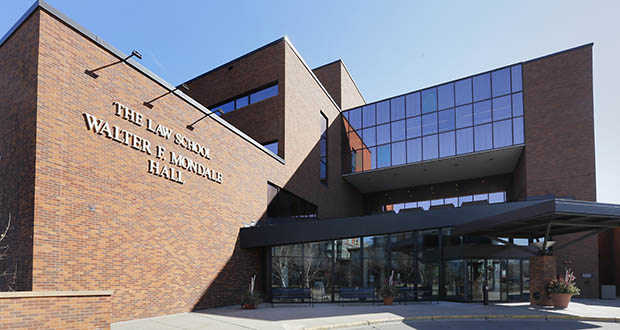

University of Minnesota Law School
Minneapolis, United States of America


Master of Laws (LLM), one year, general or in business law

<p><strong>Admissions</strong></p><p>application through the LSAC portal opening on 1 October 2026, rolling review from November, deadline 1 May 2027, $75 fee. CV, personal statement, transcripts from all institutions, two letters of recommendation. English: TOEFL 80 on the old scale or 4.5 on the January 2026 scale, preference above 100 or 5; IELTS 6.5, preference for 7.5; waivers rare, case by case. No LSAT. Virtual interview possible. Autumn intake only, one-year deferral case by case.</p><p><strong>Who it is for</strong></p><p>a lawyer holding a law degree obtained outside the United States who wants to acquire American law or specialise in one year, from August to May. The general LLM allows a choice of one of twelve concentrations (12 to 15 credits), including human rights, international law, arbitration and alternative dispute resolution, intellectual property and technology, environment and energy, health, immigration; the Business Law LLM requires 17 business law credits out of 24. A cohort of 40 to 60 students, attending JD classes.</p><p><strong>Fees (2026-27)</strong></p><p>tuition of $65,300, compulsory health insurance and fees of $6,650, living costs and books estimated at $20,600, a budget of $92,550. The school publishes this single rate for the LLM, with no resident and non-resident distinction, whereas the JD applies the non-resident surcharge. Every admitted student is automatically considered for a scholarship, with no separate application, but the school's funding is limited and covers tuition only; proof of resources covering the whole year is a condition for the I-20.</p><p><strong>Careers</strong></p><p>business law firms in the home country and the Twin Cities, in-house legal departments, international organisations, human rights, government and teaching. Minnesota participates in the ISIP organised by NYU. Bar: 24 credits including the introduction to American law course and a paper seminar; the LLM does not give access to the Minnesota exam, and New York requires choosing courses under Rule 520.6 as set out in the Yale profile. Bridge to the school's JD. 12-month OPT. Possible progression to the SJD.</p>

Juris Doctor (JD), three years, with a bridge from the school's LLM
<p><strong>Admissions (autumn 2025 intake)</strong></p><p>3,405 applications, 909 offers, a 26.7% admission rate, and 225 enrolled; median LSAT of 171 (166 to 173), median GPA of 3.88 (3.62 to 3.95). Application through LSAC from 1 September to 1 June, binding early decision by 31 December, $75 fee, LSAT required with no waiver at all, one letter, two-page statement. Foreign transcripts evaluated by LSAC, TOEFL or IELTS required with no published threshold. Transfer from the LLM by 1 August, dedicated form, $75 fee.</p><p><strong>Who it is for</strong></p><p>a holder of a bachelor's degree, in any discipline, who is aiming for the American bar and a career in the United States, in a law firm, with a judge, in prosecution or in the public interest. The full-time JD starts at the end of August. A foreign lawyer also has a route specific to Minnesota: as a graduate of the school's LLM, they can apply to transfer and have up to 28 LLM credits carried over, with two thirds of the credits still to be taken at Minnesota, which shortens the path.</p><p><strong>Fees (2026-27)</strong></p><p>at the non-resident rate, which applies to foreign students, tuition of $64,944, fees of $2,766, housing and meals of $20,510, books, transport and personal expenses, a budget of $97,708 over nine months, health insurance of $3,590 extra; Minnesota residents pay $54,024. Merit scholarships from $5,000 to full tuition, awarded at admission with no separate application; the school offers no scholarship to transfer students. Federal loans closed to foreign students.</p><p><strong>Careers</strong></p><p>law firms (45% of the class of 2025), clerkships with federal and state judges (27%), public interest (11%), government (9%), business (7%). 96% employment and a 97% Minnesota bar pass rate in July 2025 for first-time takers; 98% of students held a summer job in 2025. A network of about 13,000 alumni, including some 275 judges. The bar exam is open in every state. 12-month OPT.</p>
Doctor of Juridical Science (SJD)
<p><strong>Admissions</strong></p><p>application through the LSAC portal opening on 1 October 2026, deadline 1 March 2027 for the 2027-28 cohort, $75 fee, answer within four to six weeks. CV, personal statement, transcripts, two letters, detailed dissertation proposal and a substantial research paper in English. English: TOEFL 80 on the old scale or 4.5 on the new one, preference for 100 or 5; IELTS 6.5, preference for 7.5; scores valid for two years, MyBest not accepted. Zoom interview possible.</p><p><strong>Who it is for</strong></p><p>the future academic or senior civil servant holding a first law degree and an LLM, ideally a foreign first degree supplemented by an LLM from an ABA-approved law school. The doctorate requires a dissertation of publishable quality making an original and lasting contribution, prepared under the supervision of a faculty member. The cohort is very small: five doctoral candidates currently enrolled, from Asia and the Gulf, and eight graduates between 2018 and 2024, none from Africa.</p><p><strong>Fees (2026-27)</strong></p><p>the SJD is charged like the LLM, with tuition of $65,300, $6,650 for compulsory health insurance and fees, and $20,600 for living costs and books, a budget of $92,550 for the coursework year. The doctorate is not fee-exempt: the school indicates limited funding, with every admitted student automatically considered for a scholarship, and requires proof of sufficient resources. The cost of the dissertation phase, under continuous enrolment, is not published.</p><p><strong>Careers</strong></p><p>higher education and research in the home country, the judiciary, government and regulators, international organisations. The programme comprises 24 course credits beyond the LLM, two thirds of them graded with a GPA of at least 3.0, then 24 dissertation credits, a presentation and an oral defence. The doctorate does not change access to the bar, which depends on the first degree and the LLM. 12-month OPT, to be planned with the F-1 visa over the period of enrolment.</p>
Master of Science in Patent Law (MSPL), one year on site or online
<p><strong>Admissions</strong></p><p>rolling review, with no published deadline for the on-site programme; online version opening in September 2026 for an autumn 2027 start. No standardised test required, though a GRE, GMAT or LSAT may be submitted. TOEFL required of non-native speakers, with no published threshold, waived for a degree from an accredited American institution. Fee of $95 for an international applicant, $75 for an American applicant. Scholarships awarded automatically to qualified applicants.</p><p><strong>Who it is for</strong></p><p>a science or engineering graduate, with no legal training, who wants to become a patent agent or work in intellectual property strategy. The on-site programme lasts one year full-time, two to three years part-time, and combines patent law, business projects, and drafting of applications and licences. A fully online, asynchronous 30-credit version is taken over four semesters, without a visa. The LLM in Patent Law, for its part, is reserved for holders of an American JD.</p><p><strong>Fees (2026-27)</strong></p><p>the school aligns MSPL tuition with that of the JD, $64,944 at the non-resident rate and $54,024 for a resident, before fees, insurance and living costs, which bring the JD budget to $97,708. The online version cost a total of $61,844 for a non-resident and $51,440 for a resident in 2025-26, excluding fees, books and insurance. The school states that all its students receive a scholarship, without publishing the amount or specifying the position of foreign students.</p><p><strong>Careers</strong></p><p>intellectual property firms, patent departments of companies in medical technology, software and industry, technology transfer. Tuition includes a five-day preparation course for the Patent Bar, the federal patent agent exam, which 86% of graduates pass according to the school; 90% are employed within twelve months, with a median salary of $117,000 for a patent agent. The MSPL does not give access to a state bar. 12-month OPT depending on the programme's classification.</p>

Souhaitez-vous être accompagné ?
Nos conseillers vous guident à chaque étape.