

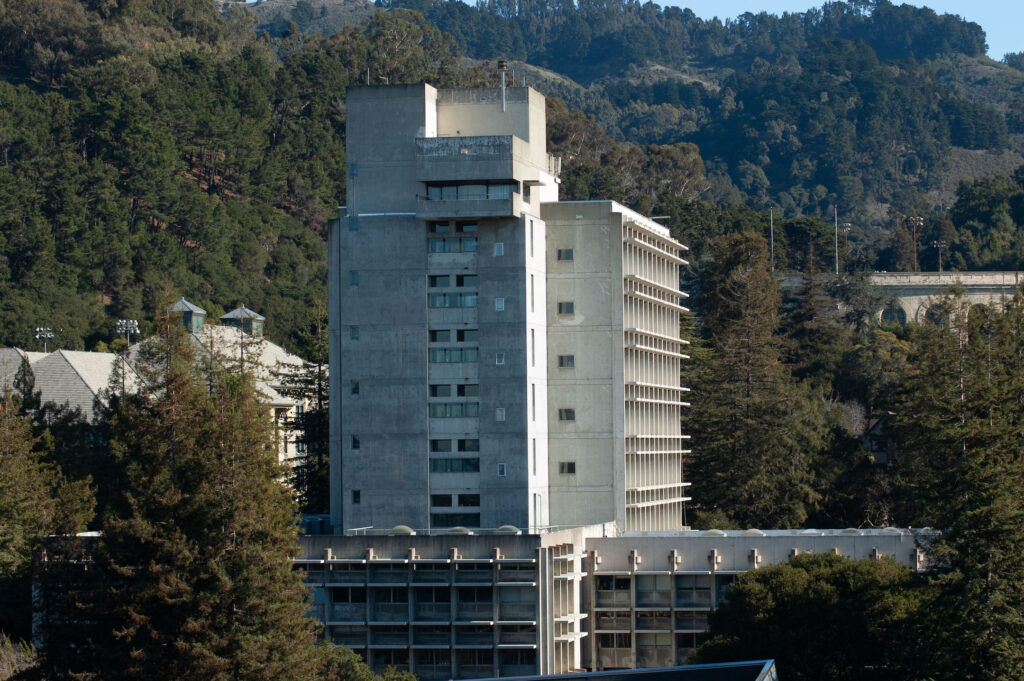

University of California, Berkeley, College of Environmental Design (CED)
Berkeley, United States of America


Master of Architecture (M.Arch), three-year track

<p><strong>Admissions</strong></p><p>online application opens in mid-September, deadline 5 January 2027, autumn entry only; fee of $155 for international applicants, plus a 4.22% processing fee, with no waiver possible. Transcripts from all institutions, translated, statement of purpose and personal statement, three letters, CV and portfolio, whose format is not published online. The GRE is not required. TOEFL of 100 on the former scale, IELTS 7, Duolingo not accepted; an equivalent bachelor's degree and a GPA of 3.0 out of 4 required. Decisions in mid-March.</p><p><strong>Who it is for</strong></p><p>holders of a bachelor's degree in any discipline, including architecture, who are aiming for their first professional degree and the American licence. The NAAB-accredited programme comprises 72 units and six studios: a first year of drawing, representation and design, a second year of architecture and urbanism with a visiting professor's studio and a trip, then an integrated design studio in the autumn and a design thesis in the spring, preceded by a research seminar.</p><p><strong>Fees (2026-27)</strong></p><p>for international students, an annual bill of $47,348.50, including $13,722 base tuition, $12,245 nonresident supplement, $9,550 professional supplement (PDST), $3,625.50 campus fees and $8,206 health insurance; with a living budget of $34,290, about $81,600 per year and nearly $245,000 for three years, excluding increases and studio material costs. Limited scholarships, merit- and need-based, usually covering part of the first year, announced with admission; the Arcus fellowship is reserved for Americans.</p><p><strong>Careers</strong></p><p>architecture practices in the San Francisco Bay Area, California and worldwide, engineering consultancies, property development, local authorities, then a return home with an accredited degree; the department also cites teaching. The college's careers service follows its graduates individually for up to two years after graduation. The M.Arch is STEM-designated and opens 36 months of OPT, enough time to accumulate a large share of the AXP hours. Licence in California or elsewhere, under the rules set out in the MIT profile. No employment rate is published.</p>

Master of Architecture (M.Arch), two-year track with advanced standing
<p><strong>Admissions</strong></p><p>same application, same 5 January 2027 deadline and same $155 fee plus 4.22% as the three-year track. The portfolio must show studio work, and the application includes a section on studios taken; foreign transcripts are provided in the original language and in English. The GRE is not required. TOEFL of 100 on the former scale, IELTS 7, Duolingo not accepted. The department publishes neither the number admitted nor any written rule on foreign five-year architecture degrees.</p><p><strong>Who it is for</strong></p><p>applicants with an outstanding undergraduate record and solid studio experience from a pre-professional bachelor's degree in architecture (BA or BS), a professional Bachelor of Architecture or a neighbouring field. The same accredited M.Arch is awarded in 52 units and four studios, with the design thesis. An architect who graduated in Africa with a non-accredited five-year degree applies to this track, but admission remains at the discretion of the committee, which may place them in the three-year track.</p><p><strong>Fees (2026-27)</strong></p><p>same bill as the three-year track, $47,348.50 per year for international students, including the $12,245 nonresident supplement, which F-1 students pay every year, and $9,550 PDST; with a living budget of $34,290, about $81,600 per year, i.e. nearly $163,000 for two years, excluding increases and studio costs. Same limited scholarships, notified in the admission letter, with no separate application. The Branner and Stump travel fellowships, up to $20,000, are for M.Arch students during their studies.</p><p><strong>Careers</strong></p><p>identical to those of the three-year track, with one year less of study and cost: American and international architecture practices, engineering consultancies, property development, planning, teaching. The accredited degree opens the path to the AXP and the ARE, and the 36 months of OPT of the STEM-designated M.Arch leave time to accumulate a large share of the required experience. A dual degree with the master's in landscape architecture or urban planning is possible, lengthening the course. No employment rate is published by the department.</p>
Master of Science in Architecture (MS)
<p><strong>Admissions</strong></p><p>online application opens in mid-September, deadline 5 January 2027, fee of $155 plus 4.22% for international applicants. Transcripts, statement of purpose and personal statement, three letters, CV, writing sample of no more than 50 pages; portfolio required only to work with Luisa Caldas or Simon Schleicher, in building science. The GRE is not mentioned. TOEFL of 100 or equivalent IELTS, Duolingo not accepted; GPA of 3.0 out of 4. Decisions from mid-March to the end of March, start of classes in mid-August.</p><p><strong>Who it is for</strong></p><p>graduates aiming for research, specialist expertise or a doctorate rather than the architectural licence. The non-accredited MS is taken in one of two fields, building science, technology and sustainability, or history, theory and society, with another topic possibly accepted with a professor's support. Neither an architecture degree nor an M.Arch is required. It comprises a minimum of 36 units, including 16 of graduate architecture courses, and concludes with a thesis or project report; the best students may apply to the doctorate.</p><p><strong>Fees (2026-27)</strong></p><p>academic graduate rate, without PDST: an annual bill of $40,655.50 for international students, including $13,722 base tuition, $15,102 nonresident supplement, $3,625.50 campus fees and $8,206 health insurance. With a living budget of $32,962 (housing, food, books, transport, personal expenses), the cost of attendance reaches about $73,600 per year, excluding increases. The department publishes no scholarship or assistantship reserved for the MS; personal funding should be planned.</p><p><strong>Careers</strong></p><p>energy performance consultancies, sustainability consulting, applied research, building and energy administrations, publishing and heritage for the history field, then a doctorate. The MS in building science carries CIP code 04.0902, on the STEM list, and opens 36 months of OPT; the history and theory field is treated, as a precaution, as 12 months. The degree does not give access to the architectural licence, which requires an accredited M.Arch under the rules set out in the MIT profile. No employment rate is published.</p>
Bachelor of Arts in Architecture (BA), four years
<p><strong>Admissions</strong></p><p>application through the university's undergraduate admission, form opens on 1 August, submission from 1 October to 30 November, with no portfolio. Transfer accepted only into the third year, with 60 transferable semester units and prerequisites completed. According to University of California data, Berkeley admitted 11.4% of first-year applicants for autumn 2025, and 6.1% of international applicants. The college does not publish a rate specific to architecture.</p><p><strong>Who it is for</strong></p><p>secondary school graduates who want to study architecture from the bachelor's level at a major research university, knowing that the BA is pre-professional and not accredited. The first year combines general courses and an introduction to environmental design, the second opens the studios, the last two include six studios in total, with history, technology and humanities. The BA prepares for an entry-level job in a practice or, in the "4 + 2" model, for the two-year track of the accredited M.Arch, at Berkeley or elsewhere.</p><p><strong>Fees (2026-27)</strong></p><p>for a nonresident living on campus, $18,214 tuition and fees, $39,270 nonresident supplement, $16,640 housing, $7,000 food and $5,066 health insurance, i.e. $86,190 in charges, and about $93,900 cost of attendance with books, transport and personal expenses. Every admitted international student is considered, with no separate application, for the Regents' and Chancellor's Scholarship; the Robinson (sub-Saharan Africa) and Swaniker (Africa, by nomination) programmes can cover need, the latter up to the full cost, for four years.</p><p><strong>Careers</strong></p><p>entry-level jobs in architecture, landscape or urban planning practices, then above all a master's: the two-year track of the M.Arch, at Berkeley or another accredited school, which leads to the professional degree in six years in total. The BA alone is not enough for the architectural licence in most jurisdictions, under the rules set out in the MIT profile. The STEM designation of the bachelor's degree is not published: as a precaution, 12 months of OPT.</p>
Doctor of Philosophy in Architecture (PhD)
<p><strong>Admissions</strong></p><p>application opens in mid-September, deadline 5 January 2027, fee of $155 plus 4.22% for international applicants. Transcripts, statement of purpose and personal statement, three letters, CV, writing sample of no more than 50 pages, lists of publications and awards; portfolio only to work with Luisa Caldas or Simon Schleicher. The GRE is not mentioned. TOEFL of 100 or equivalent IELTS, Duolingo not accepted. The number admitted is not published; decisions from mid-March to the end of March.</p><p><strong>Who it is for</strong></p><p>future academics or experts advising public authorities who intend to research building science, technology and sustainability (passive design, comfort, zero-energy buildings, natural materials) or history, theory and society (20th-century architecture, globalisation). The doctorate requires a minimum of 48 units, two years of residence, a written and oral qualifying examination and a dissertation, with a foreign language requirement in the history field. A master's is not explicitly required.</p><p><strong>Fees (2026-27)</strong></p><p>academic rate of $40,655.50 per year for international students, including $15,102 nonresident supplement and $8,206 health insurance, plus a living budget of $32,962. The university aims to fund every admitted doctoral student, through fellowships and teaching or research assistantships, and states that the nonresident supplement for international students is usually covered beyond the first year. The department publishes neither a guaranteed duration nor a stipend amount for 2026-27: these appear in the funding letter attached to the admission.</p><p><strong>Careers</strong></p><p>higher education and research in architecture in the United States, Africa and elsewhere, energy and building research institutes, administrations and specialist consulting. The doctorate in building science carries CIP code 04.0902, on the STEM list, and opens 36 months of OPT; the history and theory field is treated, as a precaution, as 12 months. The doctorate does not give access to the architectural licence, which requires an accredited M.Arch. The outcomes of doctoral graduates are not published on the pages consulted.</p>

Souhaitez-vous être accompagné ?
Nos conseillers vous guident à chaque étape.