

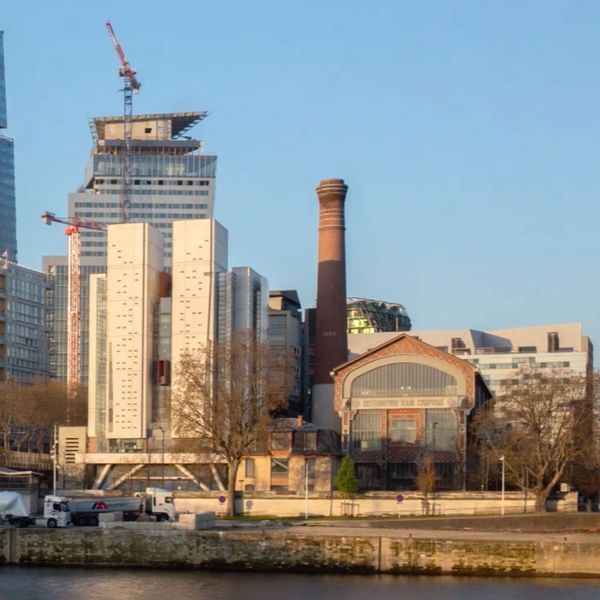
ENSA Paris-Val de Seine
Paris, France


Bachelor's Degree in Architecture (3 years)

<p><strong>Admissions</strong></p><p>Admission begins with a detailed examination of the school record after an application through Parcoursup for a French or European school leaver. The first sifting retains roughly <strong>a thousand candidates</strong> for an individual interview, a considerable figure reflecting the size of the institution. The oral is held before a panel of <strong>two members of staff and one master's student</strong>, a student presence few schools provide for in their panel composition. The expectations stated are explicit: to show curiosity, openness of mind and engagement with the world, involvement in cultural, musical or associative activities being valued. For a candidate who already holds the baccalauréat, the school recommends <strong>making use of their post-school route</strong> to confirm their plans. A non-EU national holding a foreign qualification falls under the <strong>prior admission application</strong>, the blue file specific to schools of architecture, closing on <strong>15 December</strong>.</p><p><strong>Who it is for</strong></p><p>The bachelor's cycle leads to the diploma of studies in architecture. The criteria for examining the file are published with useful precision: panels draw on the marks of the final two school years in <strong>science or mathematics, history and geography, and modern languages</strong>, in the specialisms followed, as well as on the results of the early French papers. That list shows that no subject dominates: a literary and a scientific profile are assessed there on comparable bases.</p><p><strong>Fees</strong></p><p><strong>€391</strong> a year for <strong>2026-2027</strong>, plus <strong>€105</strong> for the student life and campus contribution. That amount applies <strong>whatever the nationality</strong>, the school stating on its own site that the reform of registration fees for international students <strong>does not concern the national schools of architecture</strong>. A non-EU student therefore escapes the €2,902 in differentiated fees charged at bachelor's level at university. Scholarship holders are exempt from both the fees and the contribution.</p><p><strong>Careers</strong></p><p>The bachelor's cycle confers the diploma of studies in architecture and opens continuation into the master's. According to the survey of the school's graduates, <strong>the majority practise as architects in the Paris region</strong>.</p>

Master's Degree, State Diploma and Specialised Master's
<p><strong>Admissions</strong></p><p>Access to the master's comes through continuation of the course or by admission part-way through, a non-EU national falling under the <strong>prior admission application</strong>, the blue file, closing on <strong>15 December</strong>. The admission session for the specialised master's remains open, by contrast, <strong>until 30 August</strong>, a late calendar that contrasts with the January deadlines of the initial courses. A French-speaking candidate who is already an architect, seeking a short specialisation without going through a full course again, finds an accessible door there.</p><p><strong>Who it is for</strong></p><p>The master's degree leads to the State diploma of architect, with projects oriented towards the environment, refurbishment, mobility and digital architecture. The school moreover awards a <strong>specialised master's</strong> devoted to adaptation, training professionals able to reconcile ecological transformation, heritage and environments in rethinking territories. That positioning, at the intersection of climate and built heritage, matches a growing demand from international donors and local authorities.</p><p><strong>Fees</strong></p><p><strong>€537</strong> a year for the master's in <strong>2026-2027</strong>, plus <strong>€105</strong> for the student life contribution, <strong>whatever the nationality</strong>. Scholarship holders are exempt. The <strong>specialised master's</strong> falls on the other hand under a distinct regime: accredited by the Conférence des grandes écoles and not awarded under the national scale, it applies its own tuition, to be checked with the school. Its session open until 30 August does however leave time to assemble funding, which the January calendars do not allow.</p><p><strong>Careers</strong></p><p>The State diploma opens the design professions, with a marked orientation towards the environment, refurbishment and digital architecture. The specialised master's prepares students for roles in adapting territories to climate change, articulating built heritage and environments, a field in which international donors fund growing programmes.</p>
Double Architect-Engineer Course and Common First Year
<p><strong>Admissions</strong></p><p>Each of these routes constitutes a <strong>separate application</strong> on Parcoursup, with its own criteria and its own panel. The school warns without euphemism about the double course: the level of selection there has been <strong>particularly high</strong> given the number of candidates against a limited number of places, and <strong>the motivation interview carries substantial weight</strong>. A non-EU candidate falls under the <strong>prior admission application</strong>, the blue file, closing on <strong>15 December</strong>.</p><p><strong>Who it is for</strong></p><p>The school runs two crossover routes few institutions offer at the same time. The <strong>double architectengineer course</strong>, run with a specialist building school, and a <strong>first year common to architecture, art and design</strong>, run with a school of art and design. That second format allows the choice between three creative disciplines to be deferred by a full year, rather than decided on leaving school, and forms part of programmes intended to <strong>promote equal opportunity</strong> in access to the leading cultural institutions for pupils from modest backgrounds.</p><p><strong>Fees</strong></p><p>The architecture years fall under the Ministry of Culture scale, <strong>€391</strong> at bachelor's level and <strong>€537</strong> at master's level for <strong>2026-2027</strong>, plus <strong>€105</strong> for the student life contribution, with no differentiated fees. One reservation for the double course: the partner specialist building school is a private institution, whose tuition bears no comparison with that of a national school and must be checked before submitting that application. The common first year with the art school falls under the scale of the institution of registration for that year.</p><p><strong>Careers</strong></p><p>The double course confers the dual qualification of architect and engineer. The common first year then opens onto architecture, art or design, which turns a year of hesitation into a year of credited study, within an equal opportunity scheme.</p>

Souhaitez-vous être accompagné ?
Nos conseillers vous guident à chaque étape.