

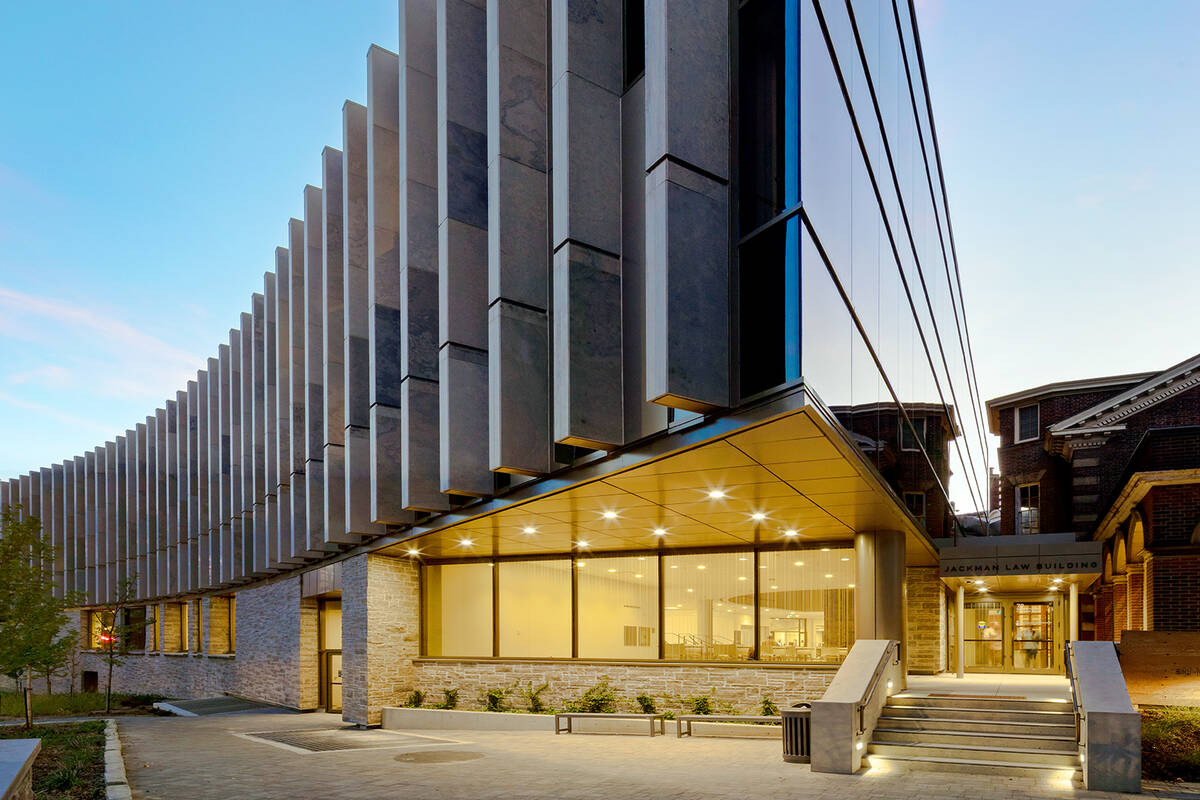

University of Toronto, Henry N. R. Jackman Faculty of Law
Toronto, Canada


Juris Doctor (JD)

<p><strong>Admissions</strong></p><p>Applications go through the Ontario service OLSAS, before <strong>1 November 2026</strong> for entry in 2027. The faculty requires at least three years of full-time university study, an undergraduate degree completed by entry, and the LSAT with no exception whatsoever. The medians of the 2025 class set the level: <strong>168</strong> on the LSAT and <strong>3.90</strong> out of 4.0.</p><p>No English test is required, no letter of recommendation is read and there is no interview: the application rests on grades, the LSAT and a personal statement of 5,000 characters at most. Degrees obtained outside Canada and the United States must be assessed by WES Canada before the application is filed.</p><p><strong>Who it is for</strong></p><p>The Juris Doctor is the faculty's professional common law degree, the one that opens the bar admission process in Canada's common law provinces. It lasts three years, full time and in person only, with no distance option and a single intake a year: first year begins in mid-August. It is aimed not at the baccalauréat holder but at the student who has already completed university studies. The class that entered in 2025 has <strong>219</strong> students selected from <strong>2,771</strong> applicants.</p><p><strong>Fees</strong></p><p>Amounts converted at the rate of <strong>CA$1 = €0.62</strong>. In 2026-27, the international student pays <strong>€45,130</strong> (CA$72,790) in tuition per year, excluding ancillary fees and insurance, and the fee schedule announces <strong>€47,387</strong> (CA$76,430) for 2027-28. An Ontario resident pays CA$33,040 and another Canadian CA$41,340. The application costs <strong>€124</strong> (CA$200), plus <strong>€71</strong> (CA$115) per faculty chosen. A decisive point: public loans and the JD financial aid programme are reserved for Canadian students.</p><p><strong>Careers</strong></p><p>The graduate enters the licensing process of the Law Society of Ontario, made up of examinations and articling, or that of another province. The faculty does not publish a dated placement rate. To the lawyer who already holds a foreign degree, it points out that the JD is not necessarily required to practise in Canada and advises approaching the NCA first.</p>

Master of Studies in Law (MSL)
<p><strong>Admissions</strong></p><p>A graduate degree is needed, ideally a doctorate, obtained with the equivalent of a Toronto B+ in the final year. The application brings together transcripts, curriculum vitae, personal statement, writing sample and two academic letters of recommendation. The English thresholds are high: <strong>100</strong> on the TOEFL iBT with 24 per section, or <strong>7.5</strong> on the IELTS with 7.0 per component. The faculty admits only a few people a year.</p><p>As at 3 October 2026, the application dates for 2027-28 were still to be announced. As a precaution, aim for a complete application at the beginning of December 2026, the deadline for the neighbouring master's.</p><p><strong>Who it is for</strong></p><p>The Master of Studies in Law is aimed at established academics in a discipline other than law, who already work and publish on neighbouring subjects and want to acquire a grounding in the foundational subjects. It is neither a bridge to the profession nor a degree for lawyers: the faculty writes that the programme does not, by itself, qualify anyone to practise law in Canada. It lasts one year full time, on an intensive basis, or is spread over two academic years part time.</p><p>The programme comprises <strong>24 credits</strong>. The student takes at least three first-year subjects from among contracts, torts, property, criminal law, constitutional law and civil procedure, as well as a compulsory seminar and a written paper.</p><p><strong>Fees</strong></p><p>In 2026-27, the international student pays <strong>€23,802</strong> (CA$38,390) in tuition for the year, and the fee schedule announces <strong>€24,992</strong> (CA$40,310) for 2027-28, against CA$9,280 for a Canadian. Enrolment course by course comes to <strong>€5,277</strong> (CA$8,511) per half course for a foreign student. The application fee amounts to <strong>€81</strong> (CA$130), non-refundable. No funding specific to the programme is announced.</p><p><strong>Careers</strong></p><p>The degree enriches an academic or research career already under way: an economist, a political scientist, a philosopher or a physician gains the ability to read and discuss positive common law. It gives access neither to the NCA nor to the bar, and an African lawyer will find no equivalence route in it.</p>
Master of Laws (LLM)
<p><strong>Admissions</strong></p><p>An LLB or a JD from a recognised university is needed, with the equivalent of a Toronto B+ in the final year. Applications for 2027-28 have been open since 16 September 2026 and close on <strong>6 December 2026</strong>, for decisions in late March or early April. The application includes transcripts, curriculum vitae, writing sample, two letters of recommendation and, for the thesis, a 750-word proposal.</p><p>English thresholds: <strong>100</strong> on the TOEFL iBT with 24 per section, or <strong>7.5</strong> on the IELTS with 7.0 per component. The faculty issues no offer conditional on later success in a test.</p><p><strong>Who it is for</strong></p><p>The Master of Laws is a one-year academic master's for holders of a first law degree. Two formats coexist. The coursework format comprises <strong>24 credits</strong> with no thesis. The thesis format combines 18 credits of courses and a thesis of 5 to 7 credits, that is 14,500 to 23,000 words, submitted by 31 July at the latest. Four concentrations are offered: business law, criminal law, health law and policy, legal theory. The 2026-27 cohort has <strong>31</strong> admitted students, 12 of them in the thesis format, from 17 countries.</p><p>The central warning is written by the faculty: the master's does not qualify a foreign-trained lawyer to practise in Ontario, and its students cannot take the first-year JD courses, the ones the NCA requires.</p><p><strong>Fees</strong></p><p>In 2026-27, the international student pays <strong>€35,179</strong> (CA$56,740) in tuition, and the fee schedule announces <strong>€36,940</strong> (CA$59,580) for 2027-28, against CA$9,280 for a Canadian. The application fee amounts to <strong>€84</strong> (CA$135). Aid is granted to a small number of applicants with an excellent record and limited means, foreign students included, with no published amount.</p><p><strong>Careers</strong></p><p>The master's prepares for research, teaching, international organisations and specialised advisory roles. The thesis format serves as a step towards the doctorate. It does not open the Canadian bar.</p>
Global Professional Master of Laws (GPLLM)
<p><strong>Admissions</strong></p><p>Neither the LSAT nor professional experience is required for this concentration. A B average in the final year is needed, and the NCA assessment, asked of every foreign lawyer, can be supplied after admission. Three rounds are open for 2027: <strong>2 November 2026</strong>, 1 March and 3 May 2027. Foreign applicants would do well to aim for the first two in order to obtain the study permit. English thresholds: <strong>100</strong> on the TOEFL iBT or <strong>7.5</strong> on the IELTS, with no conditional offer.</p><p><strong>Who it is for</strong></p><p>The Global Professional Master of Laws is a professional master's with three concentrations. The one that matters for our readers is called Canadian Law in a Global Context: it is designed for foreign-trained lawyers and built on the requirements of the NCA. Ten courses are taken in one year, or in two years in the extended format, in person only in downtown Toronto, on a Friday evening and a full Saturday every two weeks. The intake is in September.</p><p>The programme puts the compulsory Canadian subjects first and offers contracts, property and torts as options. The 2026-27 class has <strong>28%</strong> civil law lawyers and <strong>45%</strong> students whose first language is not English.</p><p><strong>Fees</strong></p><p>In 2026-27, the international student pays <strong>€51,863</strong> (CA$83,650) in tuition, a total that is identical over one or two years, against CA$34,240 for a Canadian. To this are added <strong>€1,421</strong> (CA$2,292) in ancillary fees and <strong>€588</strong> (CA$948) for health insurance, due for each year of enrolment. Acceptance requires a deposit of <strong>€930</strong> (CA$1,500). The programme offers neither scholarship nor funding of its own.</p><p><strong>Careers</strong></p><p>The degree does not amount to equivalence. It remains to obtain the NCA's certificate of qualification, then to pass the examinations and articling of the Law Society of Ontario. A civil-law lawyer must expect a longer list of subjects than a common law lawyer, and should check with the NCA that a single year in person is enough for their file.</p>
Doctor of Juridical Science (SJD)
<p><strong>Admissions</strong></p><p>The normal route requires an LLB or a JD and a master's in law, with the equivalent of a Toronto B+; direct entry requires an A- average. The application brings together transcripts, curriculum vitae, personal statement, writing sample, two letters of recommendation and above all a thesis proposal of five to ten pages. English thresholds: <strong>100</strong> on the TOEFL iBT with 24 per section, or <strong>7.5</strong> on the IELTS with 7.0 per component, results less than 24 months old, with no offer conditional on a future test.</p><p>As at 3 October 2026, the application dates for 2027-28 were still to be announced. As a precaution, the applicant prepares a complete application for the beginning of December 2026, the deadline for the neighbouring master's, and checks the date as soon as it is published.</p><p><strong>Who it is for</strong></p><p>The Doctor of Juridical Science is the faculty's research doctorate. It lasts three years full time, with a limit of five years, and requires six terms of full-time residence. Direct entry without a master's exists, over five years with a limit of six. The faculty admits five to six doctoral students a year from more than a hundred applications. It states that <strong>85%</strong> of graduates since 2015 hold an academic post and that its students have won 45 external doctoral awards over the same period.</p><p><strong>Fees</strong></p><p>The doctorate escapes the international rate. In 2026-27, tuition amounts to <strong>€3,850</strong> (CA$6,210) whatever the residence status, and to <strong>€3,962</strong> (CA$6,390) in 2027-28. Every doctoral student receives guaranteed funding equivalent to <strong>€24,800</strong> (CA$40,000) per year, tuition included, for three years. The application fee is <strong>€81</strong> (CA$130). Beyond the third year, funding is no longer guaranteed, and employment during studies is limited to ten hours a week.</p><p><strong>Careers</strong></p><p>The doctorate leads to teaching and research in law, in Canada and abroad. It does not satisfy the NCA's requirements and does not open the bar. For an African academic holding a master's in law, it is the faculty's funded route, provided a solid thesis proposal is presented.</p>

Souhaitez-vous être accompagné ?
Nos conseillers vous guident à chaque étape.