

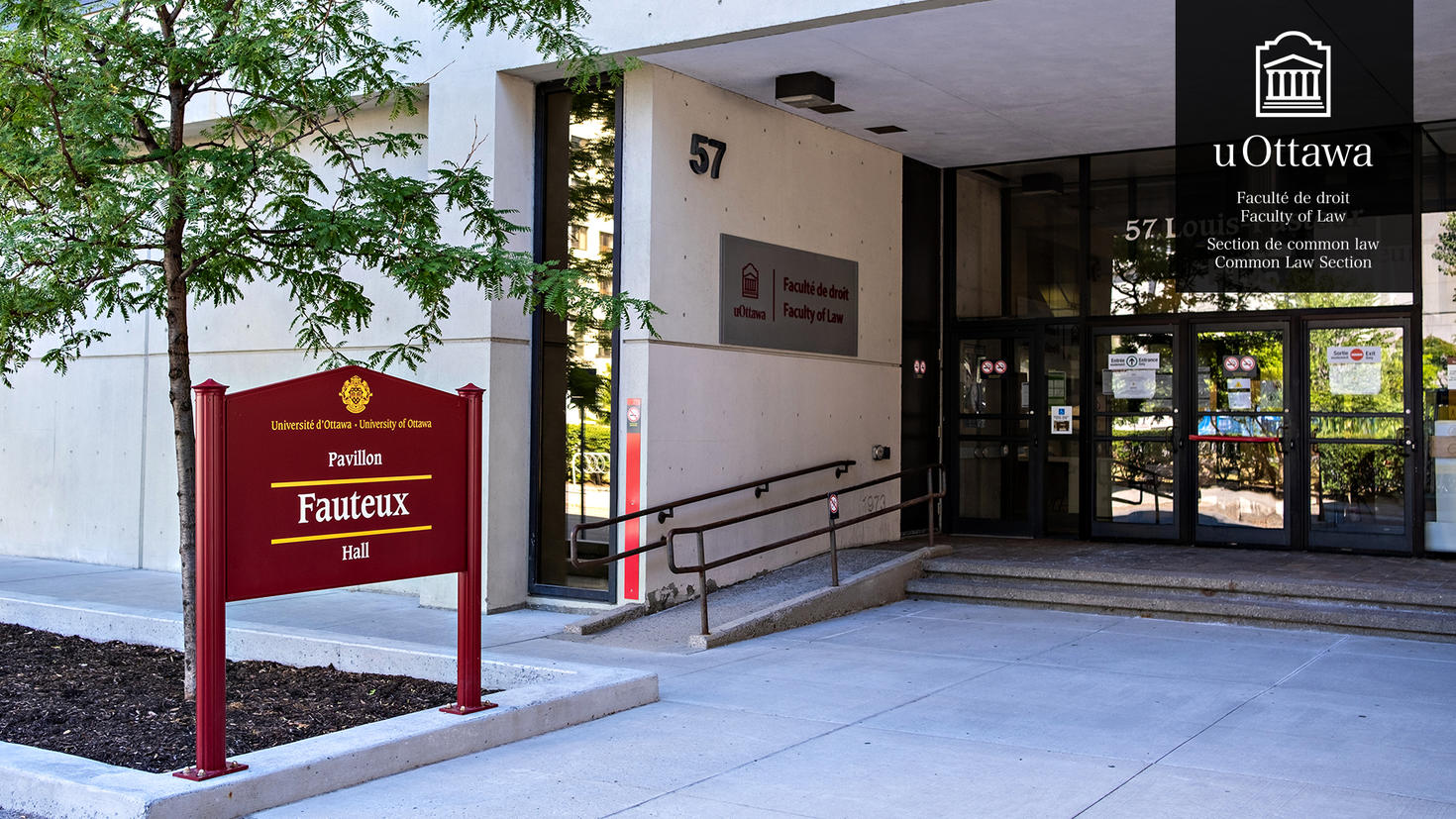
University of Ottawa, Faculty of Law (Civil Law Section and Common Law Section)
Ottawa, Canada


Licence en droit (LL.L.)

<p><strong>Admissions</strong></p><p>The faculty requires a Quebec college diploma (diplôme d'études collégiales) with an average of at least <strong>80%</strong> or a university year of 30 credits with <strong>78%</strong>. Foreign qualifications are converted to the university's scale. With no country-by-country grid read at source, a baccalauréat holder from French-speaking Africa should plan to present a successfully completed first year of university, a cautious reading as at 3 October 2026. Places are capped and decisions arrive from November, in the order in which files are received.</p><p><strong>Who it is for</strong></p><p>The Licence en droit (LL.L., Licentiate in Law) is the faculty's civil law degree: <strong>99 credits</strong> in <strong>three years</strong> full-time, six years at most part-time, entirely in French. It trains students in the private and public law of Quebec, familiar ground for a reader from the civil law tradition. The curriculum reformed in 2023 includes three « Compétences des juristes » (lawyers' skills) courses (case analysis, advocacy and mediation, essay) and a block of cross-cutting themes. A co-op option, exchanges and clinic placements complete the offer.</p><p><strong>Fees</strong></p><p>Amounts converted at the rate of <strong>CA$1 = €0.62</strong>. The schedule specific to the Licence was not readable at source on 3 October 2026. The university's published standard example for an international undergraduate in 2026-27 reaches <strong>€19,581</strong> (CA$31,582.15) in tuition per term and <strong>€40,403</strong> (CA$65,165.81) a year, insurance and ancillary fees included, against €1,925 (CA$3,104.96) per term for an Ontarian. The partial exemption scholarship, tied to programmes in French, is renewable over <strong>12 terms</strong> at most; its value in law is not published.</p><p><strong>Careers</strong></p><p>The Licence opens the École du Barreau du Québec and the Maîtrise en droit notarial (master's in notarial law) recognised by the Chambre des notaires (Quebec's notarial regulator), hence practice in Quebec. Alone, it does not open the common law bars. The National Program adds the Juris Doctor in eight months and 30 credits, subject to a civil law degree from a Canadian institution, an average of at least B and command of both languages. The faculty cites careers as lawyer, notary, tax specialist, mediator and diplomat, with no dated placement rate.</p>

Juris Doctor (JD)
<p><strong>Admissions</strong></p><p>Applications go through OLSAS. Applicants must have completed 90 university credits before entry; most of those admitted present an average of A- and, in English, an LSAT of <strong>158</strong> or more. The LSAT is not required for the French programme, which may impose a French test. The deadlines are <strong>1 November 2026</strong> in English and <strong>1 February 2027</strong> in French. Any degree obtained outside Canada and the United States requires an assessment by World Education Services.</p><p>National Committee candidates apply to the upper years by <strong>1 May</strong>, without the LSAT, provided they have received equivalences. Without any equivalence, all three years must be taken, and these requirements cannot be met as a special student.</p><p><strong>Who it is for</strong></p><p>The Juris Doctor is the common law degree, in three years, which prepares for the bars of Ontario and the other common law provinces. It exists in two full versions: the English programme, about <strong>280</strong> new students a year, and the French common law programme, about <strong>80</strong>. The Programme de droit canadien (Canadian Law Programme), created in September 2008 and limited to <strong>20</strong> students, awards the Licence en droit (LL.L., the civil law degree) and the Juris Doctor in three years, in French, with English required.</p><p><strong>Fees</strong></p><p>The Juris Doctor schedule was not readable at source on 3 October 2026. Failing that, the university's standard example for an international undergraduate in 2026-27, <strong>€19,581</strong> (CA$31,582.15) per term and <strong>€40,403</strong> (CA$65,165.81) a year with insurance and ancillary fees, serves as a cautious floor; the Ontarian example is €1,925 (CA$3,104.96) per term. The application fee is <strong>€71</strong> (CA$115), and the same again for the French test where applicable. The French programme's access to the partial exemption is not confirmed.</p><p><strong>Careers</strong></p><p>The graduate enters the licensing process of their province's bar, in Ontario that of the Law Society of Ontario. The French programme trains lawyers able to practise common law in French, an asset in a bilingual federal capital. Legal clinics, moot courts, placements and mentoring complete the training. No dated placement rate is published.</p>
Master of Laws (LL.M.)
<p><strong>Admissions</strong></p><p>An undergraduate degree in law from a Canadian university or an equivalent foreign qualification is required, with an average of at least <strong>70%</strong> (B). Legal experience and letters of recommendation also count. The only intake is in the autumn, with a deadline of <strong>1 February</strong>, for Canadians and international applicants alike; quotas may be reached before that date. Applicants without legal training are very rarely admitted, and the proposed topic must match the expertise of the teaching staff.</p><p><strong>Who it is for</strong></p><p>The LL.M. is aimed at lawyers who already hold a degree and want to specialise or move into research. It comes in three formats, with thesis, with research paper or by coursework, for an expected duration of two years full-time. The research paper format carries eight concentrations: environmental law, international trade and foreign investment, law and social justice, law and technology, humanitarian law and international security, notarial law, health law, legislative studies. Courses, papers and thesis are done in French or in English.</p><p><strong>Fees</strong></p><p>The university's standard example for graduate studies in 2026-27 sets international tuition at <strong>€6,085</strong> (CA$9,815.26) per term, or <strong>€20,206</strong> (CA$32,590.61) for three terms with insurance, against €1,554 (CA$2,505.83) per term for an Ontarian; the schedule specific to law remains to be confirmed. The partial exemption scholarship is worth <strong>€3,410</strong> (CA$5,500) per term at the Faculty of Law, over <strong>6 terms</strong> at most. It requires full-time study and either a programme offered in French or two years of previous study in French.</p><p><strong>Careers</strong></p><p>The LL.M. does not in itself satisfy the requirements of the National Committee on Accreditation: it does not give access to the common law bars. It serves specialisation and preparation for the doctorate, with an accelerated transfer possible from 80% in three courses. The notarial law concentration is the route recognised by the Chambre des notaires du Québec (Quebec's notarial regulator). In 2026, a master's degree at a public institution is exempt from the provincial attestation letter for the study permit.</p>
Doctorate in Law (Ph.D.)
<p><strong>Admissions</strong></p><p>The faculty requires a master's degree in law with an average of at least <strong>75%</strong> (B+), or an equivalent foreign degree with comparable results, as well as a demonstrated aptitude for legal research and writing. An applicant whose first language is neither French nor English must prove their proficiency in one of the two. Entry is in the autumn only, with a deadline of <strong>1 February</strong>. The proposal must have a clear legal focus and match the expertise of a professor.</p><p><strong>Who it is for</strong></p><p>The doctorate trains researchers and academics. Its normal duration is <strong>four years</strong>, or 12 terms, with a maximum of six years. The pathway comprises a 3-credit course in legal methodology and theory, a 3-credit optional course, a comprehensive examination, an examination of the thesis proposal, then the thesis itself, of <strong>90,000 to 120,000 words</strong> excluding tables, bibliography and appendices. The defence takes place before a panel of at least four members. The programme is taken in French or in English.</p><p><strong>Fees</strong></p><p>The international doctoral student enrolled full-time pays the tuition of Canadians residing outside Ontario, and not the international rate, as long as they progress normally. The exact amount of this rate was not read at source as at 3 October 2026; as a benchmark, the published example for an Ontarian in graduate studies is <strong>€1,554</strong> (CA$2,505.83) per term in 2026-27, the out-of-Ontario rate being higher. The international doctoral scholarship amounts to <strong>€27,900</strong> (CA$45,000) over five years. Graduate tuition is frozen in 2026-27.</p><p><strong>Careers</strong></p><p>The doctorate leads to university teaching and research. It is not a route to the bar: like the master's degree, a research degree does not satisfy the National Committee's requirements. The doctorate at a public institution is exempt from the provincial attestation letter in 2026, and the post-graduation work permit is open to university graduates with no condition as to field. The faculty publishes no dated placement rate for its doctoral graduates.</p>

Souhaitez-vous être accompagné ?
Nos conseillers vous guident à chaque étape.