

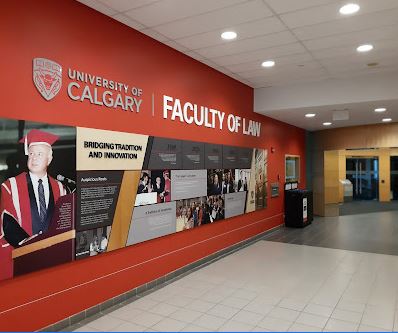
University of Calgary, Faculty of Law
Calgary, Canada


Juris Doctor (JD)

<p><strong>Admissions</strong></p><p>Applications are submitted from <strong>1 September</strong> to <strong>1 December</strong>, with an LSAT taken by <strong>31 January</strong> at the latest. A minimum of <strong>60 units</strong> of undergraduate study is required, but admission without a completed bachelor's degree is rare. Files are assessed on a rolling basis, without interview, and decisions arrive by the end of April at the latest. The best LSAT positions the file, but all scores from the last five years, their average and the number of attempts are read.</p><p>The 2026 intake took <strong>139</strong> students from <strong>1,717</strong> applications, with an average LSAT of <strong>166</strong> and an average of <strong>3.80</strong> out of 4. Transcripts not written in English require a WES evaluation, and grades from foreign degrees are read on the transcript, with no average calculated. International application fee: <strong>€90</strong> (CA$145).</p><p><strong>Who it is for</strong></p><p>The JD is the professional common-law degree, the one that leads to the bar in Alberta and in the other common-law provinces. It lasts <strong>3 years</strong> full-time, or <strong>6 years</strong> part-time, and follows the Calgary Curriculum: foundational subjects in first year, then procedure, evidence, ethics, negotiation and advocacy. For an African school leaver holding the baccalauréat, it requires university studies first; for a civil-law graduate, it is the complete route when the National Committee recognises nothing.</p><p><strong>Fees</strong></p><p>Amounts converted at the rate of <strong>CA$1 = €0.62</strong>. In 2026-27, first year costs an international student <strong>€40,619</strong> (CA$65,514), tuition and fees included, the faculty's estimate for 36 units, against <strong>€11,592</strong> (CA$18,696) for a Canadian. Billing is per course: <strong>€3,292</strong> (CA$5,309.01) per 3-unit course, to which are added about <strong>€1,120</strong> (CA$1,805.98) a year in general, student association and career service fees.</p><p><strong>Careers</strong></p><p>The graduate enters articling, then takes the Alberta bar's training course. The faculty describes its articling placement rate as high, without publishing a dated figure. Two joint degrees, with the Haskayne School of Business and the School of Public Policy, and a <strong>4-year</strong> pathway with the University of Houston Law Center, which gives two degrees and access to the bars of both countries, widen the outlets towards energy and business.</p>

Foreign Trained Lawyers Program (post-bachelor's certificate in common law for National Committee on Accreditation purposes)
<p><strong>Admissions</strong></p><p>The entry condition is a National Committee assessment report less than five years old: applicants must therefore go to the Committee before applying and, since <strong>1 March 2026</strong>, take its language screening test and complete a component on law and Indigenous peoples. The law degree must show a B-level average. Unless schooling was in English in a country where English is an official language, an IELTS Academic with no score below <strong>7.0</strong> is required.</p><p>International applicants apply by <strong>31 October 2026</strong> for a start in the last week of August 2027, Canadians and permanent residents by 30 April 2027. About <strong>30</strong> people are admitted. A civil-law graduate with no exposure to the common law should expect the Committee to require more of them than these five subjects, or even a full degree.</p><p><strong>Who it is for</strong></p><p>This <strong>12-month</strong> post-bachelor's certificate is aimed at lawyers trained outside Canada, in civil law and common law alike, and at Canadians who graduated abroad. It covers the National Committee's five compulsory subjects: criminal law, constitutional law, administrative law, foundations of Canadian law and ethics. A sixth course, in professional development, satisfies the legal research and writing requirement.</p><p><strong>Fees</strong></p><p>In 2026-27, the six compulsory courses cost <strong>€22,282</strong> (CA$35,938.38), the same rate for international and Canadian students, spread over four terms. Any additional course is billed per 3-unit course. A non-refundable deposit of <strong>€2,325</strong> (CA$3,750), credited against tuition, is due within two weeks of the offer, and the international application fee is <strong>€90</strong> (CA$145).</p><p><strong>Careers</strong></p><p>Courses passed count before the National Committee, which then issues the certificate of qualification opening the way to articling and the bar's training course. The faculty backs this with a certified career coach, mock interviews, job-shadowing placements and reserved job postings. It states that <strong>86%</strong> of the students supported say they gained clarity in their search, a satisfaction figure and not a placement rate.</p>
Graduate Certificate in Natural Resources, Energy and Environmental Law
<p><strong>Admissions</strong></p><p>A law degree is required, with an average of at least <strong>3.0</strong> out of 4 over the last two years of full-time study, that is 60 units. The file includes a curriculum vitae, transcripts and two letters of recommendation; no standardised test or research supervisor is required. For a 1 September start, the portal opens on 1 September of the preceding year and closes on <strong>6 January</strong>, with supporting documents expected by 10 January.</p><p>Proof of English follows the criteria of the graduate calendar, and the faculty grants no admission conditional on obtaining a score. International application fee: <strong>€90</strong> (CA$145).</p><p><strong>Who it is for</strong></p><p>This graduate certificate extends the faculty's historic specialism, born with the Canadian Institute of Resources Law in <strong>1979</strong>. It comprises <strong>four courses</strong>, at least one of which includes a research paper, and is taken full-time or part-time within a maximum of <strong>3 years</strong>, in person. It is aimed at the in-house lawyer, the adviser to a ministry of mines or energy, or the business lawyer who wants a short specialisation.</p><p><strong>Fees</strong></p><p>The schedule in force since spring 2026 adds up two items for the international student: <strong>€1,689</strong> (CA$2,723.70) per 3-unit course, against CA$980.34 for a Canadian, and a programme fee of <strong>€844</strong> (CA$1,361.85) per autumn and winter term, against CA$490.17. JD-level law courses are, however, billed at the JD rate, that is <strong>€3,292</strong> (CA$5,309.01) per course: the actual bill therefore depends on the choice of courses. The certificate gives no entitlement to programme funding or to the graduate scholarship competition.</p><p><strong>Careers</strong></p><p>The certificate does not give access to the bar and meets no National Committee requirement. Its value is sectoral: the credential signals competence in oil and gas, mining, water and environmental law. For a lawyer from a producing country in West or Central Africa, it serves above all on the return home, in a ministry, a national company or a firm advising operators.</p>
Master of Laws (LLM)
<p><strong>Admissions</strong></p><p>Both routes require a law degree and an average of at least <strong>3.0</strong> out of 4 over the last two years, an original piece of writing of 10 to 30 pages, a curriculum vitae and two letters of recommendation. The portal opens on 1 September and closes on <strong>1 December</strong>, and documents are due on 15 December for a start the following September. An applicant to the thesis route must name a prospective supervisor. No admission conditional on an English score is granted and nothing can be taken at a distance.</p><p><strong>Who it is for</strong></p><p>The master's exists in two forms, each with a possible specialisation in natural resources, energy and environmental law. The thesis route comprises two seminars, two elective courses and a thesis of <strong>100 to 125 pages</strong>, with two terms of residence from September to April and a maximum of 3 years. The course-based route lines up three compulsory courses, including a research paper, and five elective courses: advertised as 12 months, it lasts <strong>16</strong> in practice.</p><p><strong>Fees</strong></p><p>With thesis, the international student pays <strong>€7,089</strong> (CA$11,434.20) a year, that is CA$2,858.55 per term, against CA$4,901.40 for a Canadian, the schedule in force since spring 2026. Course-based, the student pays <strong>€1,689</strong> (CA$2,723.70) per 3-unit course, giving a floor of <strong>€13,510</strong> (CA$21,789.60) for eight courses, Qiryna calculation.</p><p>This floor is theoretical: any JD-level law course is billed at the JD rate, <strong>€3,292</strong> (CA$5,309.01). Only the thesis route is eligible for scholarships and programme funding, which the faculty says it strives to provide without always managing to.</p><p><strong>Careers</strong></p><p>The faculty writes it plainly: its graduate programmes do not qualify anyone to practise law in Canada. The master's serves sectoral expertise, teaching, the civil service, international organisations and, for the thesis route, preparation for the doctorate. It has an immigration advantage: a master's at a public institution is exempt from the provincial attestation letter in 2026 and opens the post-graduation work permit.</p>
Doctor of Philosophy in Law (PhD)
<p><strong>Admissions</strong></p><p>A master's in law or an equivalent relevant master's degree is required, with at least <strong>3.3</strong> out of 4 in the first law degree and 3.0 in the master's. The faculty specifies that those admitted usually show <strong>3.7</strong> or more in the master's. The file brings together an original scholarly text of 10 to 30 pages, a ten-page statement setting out the research interests and the thesis project, two academic references and the name of a prospective supervisor.</p><p>The portal opens on 1 September and closes on <strong>1 December</strong>, documents due on 15 December, for a start on the following 1 September. Proof of English follows the graduate calendar, with no conditional admission. International application fee: <strong>€90</strong> (CA$145).</p><p><strong>Who it is for</strong></p><p>Opened in <strong>2021</strong>, the doctorate trains researchers and future academics. It comprises two seminars, in methodology and legal theory, supervised research, a thesis proposal, written field examinations, an oral candidacy examination and then a thesis of about <strong>300 pages</strong>. The faculty expects completion in <strong>4 years</strong>, with a maximum of 6, full-time and on site; part-time study is possible only with the agreement of the programme's management.</p><p><strong>Fees</strong></p><p>The schedule for thesis-based programmes, in force since spring 2026, sets international tuition at <strong>€7,089</strong> (CA$11,434.20) a year, that is CA$2,858.55 per term, against <strong>€3,039</strong> (CA$4,901.40) for a Canadian. Over the four years expected, tuition alone would reach <strong>€28,357</strong> (CA$45,736.80), a Qiryna calculation excluding general fees and indexation. Doctoral students are eligible for scholarships and programme funding, the amount of which the faculty does not publish.</p><p><strong>Careers</strong></p><p>The doctorate leads to university teaching and research, to the institutes attached to the faculty, including the Canadian Institute of Resources Law and the Alberta Law Reform Institute, to regulatory bodies and to international organisations. It does not qualify for the Canadian bar. It does, on the other hand, benefit from the exemption from the provincial attestation letter granted in 2026 to doctorates at public institutions, and from the post-graduation work permit.</p>

Souhaitez-vous être accompagné ?
Nos conseillers vous guident à chaque étape.