

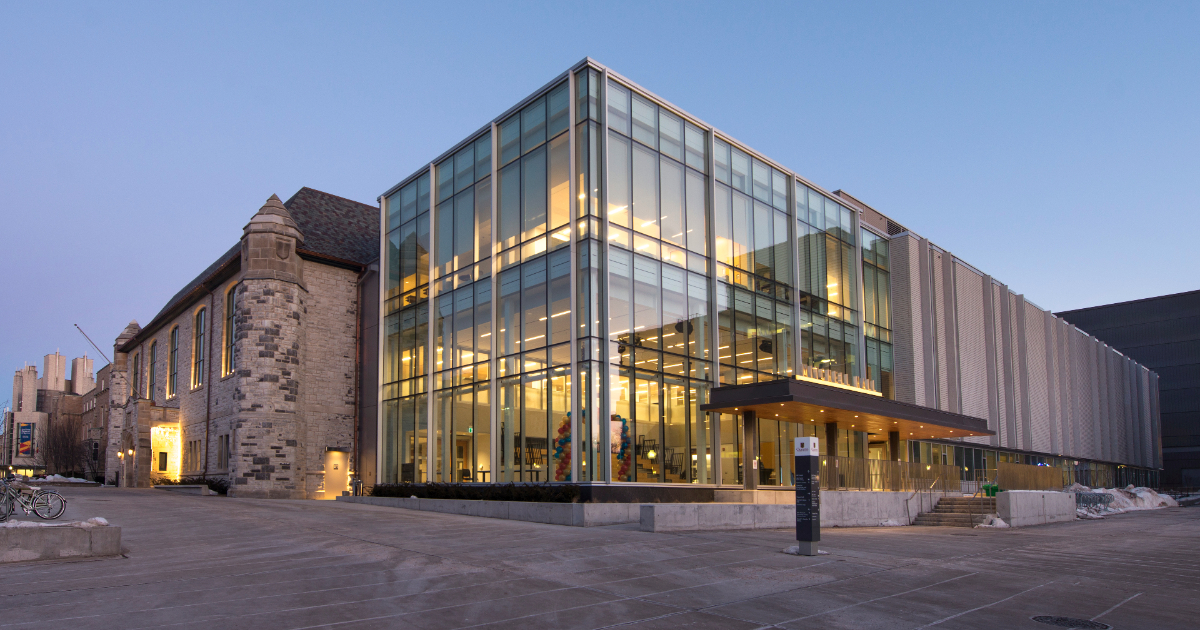

Queen's University, Smith Engineering
Kingston, Canada


Bachelor of Applied Science (BASc) in Engineering

<p><strong>Admissions</strong></p><p>Applicants need final-year secondary mathematics and science and proof of English proficiency. The citizenship status declared in the first admission application is recorded permanently and determines the fee charged.</p><p>Any later change to this status requires a separate procedure, with supporting documents and within published deadlines. A change obtained during the programme is not applied automatically.</p><p><strong>Who it is for</strong></p><p>The programme leads to an engineering degree accredited in Canada, with a specialisation chosen after a common first year. The disciplines follow the five departments, from chemical engineering to mining engineering.</p><p>Fees are calculated per unit, up to a limit of 16.1 credits per term. A student who reduces their load sees their bill fall proportionally, a mechanism absent from flat-fee schedules.</p><p><strong>Fees</strong></p><p>The 2026-27 schedule sets the international rate at <strong>CA$1,841.11 per unit</strong>, or <strong>$59,283.74</strong> in tuition for a normal load of 32.2 units. The total cost reaches <strong>$61,867.57</strong> with ancillary fees and mandatory health insurance at $948.</p><p>An Ontario resident pays $12,152.92 in tuition for the same load, and a Canadian from outside Ontario $15,205.48. In the sixth year, the international rate falls to $1,789.97 per unit.</p><p><strong>Careers</strong></p><p>The accredited degree opens the way to the Professional Engineer (P.Eng.) title after a period of supervised practice. The recruiting sectors are mining and metallurgy, chemicals and processes, infrastructure, energy, materials and information technology.</p>

Bachelor of Mining Engineering Technology
<p><strong>Admissions</strong></p><p>Applications follow the same science and language requirements as the bachelor's in engineering. A six-unit certificate in mining technologies also makes it possible to test the track before a full commitment.</p><p><strong>Who it is for</strong></p><p>This track leads to a degree in mining engineering technology, separate from the standard engineering degree. It represents 39 units a year and trains senior technicians and operational managers for the extractive industry.</p><p>It is aimed at applicants who want to work in mining without going through the accredited engineering programme, or who want a less costly entry into the sector.</p><p><strong>Fees</strong></p><p>The 2026-27 schedule sets the international rate at <strong>CA$848.68 per unit</strong>, or <strong>$33,098.52</strong> in tuition for 39 units, and <strong>$35,682.35</strong> in total with ancillary fees and health insurance.</p><p>That is a little over half the cost of the bachelor's in engineering, for the same employment sector. The certificate in mining technologies costs <strong>$5,092.08</strong> in tuition.</p><p><strong>Careers</strong></p><p>Graduates join underground and open-pit mining operations, processing plants, equipment maintenance, occupational health and safety and the technical services of extractive companies.</p><p>Unlike the bachelor's in engineering, this degree does not lead to the Professional Engineer title. An applicant who aims to register with a professional regulatory body, in Canada or in their own country, should check this point before deciding on cost alone.</p>
Master of Applied Science, thesis-based (MASc)
<p><strong>Admissions</strong></p><p>Admission requires the prior agreement of a research supervisor with the means to fund the project. Contact with the laboratory comes before the application is submitted and determines its outcome.</p><p>A bachelor's degree in engineering or science, a strong academic record and proof of English proficiency complete the requirements.</p><p><strong>Who it is for</strong></p><p>The thesis-based master's is the research track, completed over two years under the supervision of a professor and assessed through a thesis. It is the standard route into the doctorate.</p><p>In mining engineering, research covers mine evaluation, design and operation, complex processing plants and the mechanical equipment used in extraction and processing.</p><p><strong>Fees</strong></p><p>The registrar's 2026-27 schedule sets international research master's fees at <strong>CA$4,309.15 per term</strong>, or <strong>$12,927.45</strong> for a three-term year, and <strong>$15,552.94</strong> with ancillary fees, student fees and health insurance at $948. A Canadian pays $1,962.66 per term. Programme-specific ancillary fees of ten to sixty dollars are added.</p><p>Mandatory health insurance costs <strong>CA$948</strong> for a September start, $632 for a January start and $316 for a May start. Funding depends on the research supervisor and any scholarships obtained.</p><p><strong>Careers</strong></p><p>Most graduates continue to a doctorate or join industrial research and development in mining and mineral processing, materials, energy and chemical processes.</p>
Master of Engineering, professional (MEng)
<p><strong>Admissions</strong></p><p>The required degree is a bachelor's in engineering or a related discipline, together with proof of English proficiency. Deadlines vary by department.</p><p><strong>Who it is for</strong></p><p>The MEng is the professional master's, course-based. In mining engineering, it is completed in one year and prepares students to solve broad problems in the extractive industry rather than to conduct original research.</p><p>It is offered in the faculty's main disciplines and requires no prior agreement from a laboratory, which makes it the most open route into graduate programmes for an international applicant.</p><p><strong>Fees</strong></p><p>The 2026-27 schedule sets the international MEng at <strong>CA$9,987.66 per term</strong> over three terms, or <strong>$29,962.98</strong> in tuition, or $14,981.49 per term in the accelerated two-term option, for the same total. The cost reaches <strong>$32,588.47</strong> with ancillary fees and mandatory health insurance at $948. A Canadian pays $9,903.96 in tuition.</p><p>These programmes are self-funded and carry no research funding. For an engineer already working in a mining country, however, the one-year option provides a Canadian qualification without a long career break.</p><p><strong>Careers</strong></p><p>Graduates join mining companies, engineering consultancies, metallurgy, energy and technical consulting. A master's graduate can apply for a Post-Graduation Work Permit (PGWP) of up to three years, and has been exempt from the provincial attestation letter (PAL) since 2026.</p>
Doctor of Philosophy (PhD)
<p><strong>Admissions</strong></p><p>Admission rests on the agreement of a research supervisor and on an academic and research record. Prior contact with the laboratory is the first step in the application.</p><p>A French-speaking African applicant would do well to target the mining department's teams, whose research themes match those of the gold and bauxite basins of West Africa.</p><p>A bachelor's and usually a master's degree are required, with proof of English proficiency. Applications are submitted to the School of Graduate Studies according to each department's own timetable.</p><p><strong>Who it is for</strong></p><p>The doctorate is for applicants aiming at a research career in higher education or industry. It takes place within the five departments, on the Kingston campus.</p><p>Research areas cover mineral extraction and processing, chemical extraction of critical metals, materials, processes, infrastructure and electrical systems.</p><p><strong>Fees</strong></p><p>Since September 2021, an international doctoral student pays the same fees as a Canadian: <strong>CA$1,962.66 per term</strong> on the 2026-27 schedule, or <strong>$5,887.98</strong> a year, and <strong>$8,513.47</strong> with ancillary fees and health insurance at $948. Funding depends on the research supervisor, assistantships and any scholarships obtained, and is also used to pay tuition.</p><p>The doctorate has been exempt from the provincial attestation letter (PAL) since 2026 and is not subject to the field of study requirement imposed for the Post-Graduation Work Permit.</p><p><strong>Careers</strong></p><p>Careers are split between higher education, public research bodies and corporate research and development, with a concentration in mining, metallurgy and critical metals.</p>

Souhaitez-vous être accompagné ?
Nos conseillers vous guident à chaque étape.