

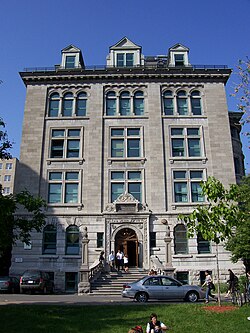

McGill University, Peter Guo-hua Fu School of Architecture
Montréal, Canada


Bachelor of Science (Architecture) (B.Sc. Arch.)

<p><strong>Admissions</strong></p><p>Admission is based on the academic record with prerequisites in mathematics and science, the school having published no numerical threshold for 2026-27. Applicants transferring from another institution must complete the prerequisite courses listed in the guidelines for transfers and second bachelor's degrees. Proof of English follows the general rules, with a TOEFL of <strong>86</strong> or an IELTS of <strong>6.5</strong>. Entry is in the autumn.</p><p><strong>Who it is for</strong></p><p>This undergraduate degree is the school's compulsory point of entry. It is not professional and does not lead to a licence, but it is the condition for access to the accredited master's. The school says so plainly: holders of a university degree in a field unrelated to architecture must go through it, as must holders of a college diploma in architectural technology, admitted as transfers. There is therefore no three-year master's at McGill open to graduates of any discipline.</p><p><strong>Fees</strong></p><p>Amounts converted at the 15 August 2026 rate of <strong>CA$1 = €0.62</strong>. The 2026-27 international fee schedule, updated in December 2025, sets tuition at <strong>CA$54,000</strong>, or <strong>€33,480</strong>, and the estimated all-inclusive total at <strong>CA$57,569</strong>, or <strong>€35,693</strong>. A Canadian from outside Quebec pays <strong>CA$12,985.50</strong>. The per-credit rate is guaranteed for the duration of the programme.</p><p>The Quebec base tuition is <strong>CA$103.92 per credit</strong>, or <strong>€64.43</strong>. A student exempted from the flat international fee under a bilateral agreement pays about <strong>€1,930</strong> for thirty credits, against €33,480 at the international rate. The annual gap of <strong>€31,550</strong> makes the exemption application, to be filed with the Ministry of Education of the home country before departure, the decisive step in the file.</p><p><strong>Careers</strong></p><p>The degree leads to McGill's professional master's or to that of another accredited school. On its own, it opens design support roles in practices, project management, heritage and operational planning, without allowing its holder to use the title of architect or to sign drawings.</p>

Master of Architecture, Professional (M.Arch. Professional, non-thesis)
<p><strong>Admissions</strong></p><p>Applicants must hold the McGill B.Sc. (Arch.) or its equivalent, with a cumulative GPA of at least <strong>3.0 out of 4.3</strong>. The school publishes a list of generally eligible degrees, which includes the pre-professional bachelor's degrees of Montréal, Laval, Toronto Metropolitan, Laurentian, Waterloo, Manitoba and Carleton, as well as UQAM's bachelor's degree in environmental design. The deadline is <strong>15 December</strong> and entry is in September only. A programme comparison table is required from applicants outside this list.</p><p><strong>Who it is for</strong></p><p>This is the institution's only degree accredited by the CACB, and it is recognised as accredited by NCARB in the United States. It comprises <strong>60 credits</strong> and is taken without a thesis. One restriction weighs heavily on African applicants: the school explicitly excludes from this programme holders of a professional degree already obtained, for example a five-year B.Arch. or its equivalent. An architect trained in Abidjan or Dakar therefore cannot enter it, and must turn to the research master's or the doctorate.</p><p><strong>Fees</strong></p><p>This non-thesis programme is charged per credit, not at the flat term rate reserved for thesis programmes. In 2026-27, an international student admitted in autumn 2026 pays <strong>CA$1,094.42</strong> per credit, or <strong>€679</strong>, against <strong>CA$103.92</strong> for a Quebec resident and <strong>CA$432.85</strong> for another Canadian admitted since 2024. Over sixty credits, the programme comes to about <strong>CA$65,665</strong>, or <strong>€40,712</strong>, a Qiryna calculation excluding society, faculty and department fees. With an exemption, only the Quebec rate remains payable.</p><p><strong>Careers</strong></p><p>The graduate enters the path to professional licensure through CACB academic certification, followed by the supervised internship and the Examination for Architects in Canada. NCARB recognition also eases mobility to the United States. Canada Graduate Scholarships, worth <strong>CA$27,000</strong> and non-renewable, are open to eligible applicants with a deadline of 1 December, two weeks before the programme's own deadline.</p>
Master of Science in Architecture, thesis (M.Sc. Architecture)
<p><strong>Admissions</strong></p><p>A bachelor's degree is required for access to the master's programme. The application comprises official transcripts, reference letters on university or company letterhead giving the referee's position and full contact details, and a research proposal overlapping with the school's research areas. These areas cover history and theory, cultural landscapes, affordable and sustainable housing, computation and fabrication, minimum cost housing, design and health, urban design and vernacular architecture.</p><p><strong>Who it is for</strong></p><p>This research degree is not accredited and does not lead to a licence. It is aimed primarily at holders of a professional degree in architecture seeking advanced research training, and it is the route for an architect already qualified outside Canada, since the professional master's is closed to them. The catalogue specifies that holders of a degree in another discipline wishing to pursue research engaging design and architecture are also invited to apply.</p><p><strong>Fees</strong></p><p>Thesis programmes are charged at a flat rate per term of residence, not per credit. In 2026-27, an international student pays <strong>CA$10,674.30</strong> per full-time term, or <strong>€6,618</strong>, against <strong>CA$1,558.80</strong> for a Quebec resident and <strong>CA$4,865.25</strong> for another Canadian, excluding ancillary fees. The exemption from the flat fee by course activity, granted as of right and not subject to quota, applies to thesis research activities in a degree programme, which covers precisely this master's.</p><p><strong>Careers</strong></p><p>The degree leads to the doctorate, applied research and consultancy, not to a licence to practise. For an architect already registered with a professional body at home, it serves as further specialisation and an academic signal, with no effect on Canadian recognition of the original degree, which falls under CACB certification through the foreign degree route. Recruiters are research centres, international organisations and large practices.</p>
Doctor of Philosophy in Architecture (Ph.D.)
<p><strong>Admissions</strong></p><p>Applicants with sufficient background at master's level in the intended research field are eligible and enter at the Ph.D. 2 level, with additional courses if necessary. A working knowledge of the language or languages relevant to the research field is required, a rare condition that can work in favour of a French-speaking applicant working on African or Quebec corpora. The application comprises references, transcripts and a research proposal.</p><p><strong>Who it is for</strong></p><p>The doctorate is designed for study beyond the professional degree and targets graduates who already have professional experience and wish to acquire specialised knowledge. The programme began as a special programme in 1989 and was approved by the Ministry of Education in <strong>1997</strong>, the first thesis being defended by Lily Chi the same year. It fits within the school's research areas, from minimum cost housing to cultural landscapes.</p><p><strong>Fees</strong></p><p>The doctorate falls under the thesis programme regime, charged per term of residence. In 2026-27, an international student pays <strong>CA$9,581.40</strong> per full-time term, or <strong>€5,940</strong>, while Quebec residents and other Canadians pay the same rate of <strong>CA$1,558.80</strong>, excluding ancillary fees. The exemption from the flat fee by course activity applies as of right to thesis research activities, which brings the doctoral bill close to the Quebec rate. Additional terms after residence are charged <strong>CA$943.33</strong> at the Quebec rate.</p><p><strong>Careers</strong></p><p>Graduates target university teaching and research, research centres on housing and climate, international organisations and advisory work for public project owners. The school's focus on housing in the Global South, carried since 1971 by the Minimum Cost Housing Program, opens thesis ground consistent with the needs of West African cities and with the funders that finance these programmes.</p>

Souhaitez-vous être accompagné ?
Nos conseillers vous guident à chaque étape.